



For decades, scientists have tried to make sense of the seemingly impossible dynamics of unidentified aerial phenomena; either to debunk the reports of impressionable witnesses, or (if the cases escape a simplistic solution despite having sufficient data) in an attempt to uncover an outlier that might lead the way to a physics breakthrough. Our friend, Italian astrophysicist Massimo Teodorani, has attempted to do the latter with the release of two papers through the portal ResearchGate.
Students of Ufology will be aware that the field can be largely divided in two camps: the ‘Nuts & Bolts’ camp tries to rationalize the phenomenon as advanced craft of indeterminate origin (presumably interstellar), controlled and possibly piloted by highly intelligent beings; the other group (sometimes called the ‘Paranormalists’, or even the derogatory ‘Love & Light’ camp by the ‘Nuts & Bolts’ advocates) interprets the phenomenon in a less ‘Sci-Fi’ manner, and often favor an approach more aligned with ancient mystic practices (i.e. Magic) that are sometimes indistinguishable from religion.
What’s interesting about Massimo’s two papers is that they seem to tackle the UFO problem from both camps. One of them— Plasma Confinement and Spacetime Engineering as Candidate Frameworks for UAP Propulsion: A Comprehensive Assessment— approaches UFOs from the assumption that they could be advanced technological objects, displaying an exotic propulsion system that eludes our current scientific understanding. The other paper— On the Hypothesis of Interactive Plasma Phenomena—is much more speculative, and entertains the possibility of (some) UFO manifestations as being the result of a non-organic form of intelligent life.
The ’Nuts & Bolts’ paper analyzes two tentative ‘frameworks’ that could try to account for the incredible performances of UFOs observed by thousands of witnesses, and sporadically documented through external instrumentation (e.g. radar returns, IR imagery, etc):
Plasma-Based Propulsion
The first framework is that UFOs may employ a sort of ‘plasma-magnetic’ system in which high EM fields would envelop the craft in a ‘sheath’ of energized plasma. Such a system would be more advanced than our current technology, because it would probably require a compact and portable fusion reactor, producing the output of a full-size energy power plant (which is far beyond our engineering capabilities); however, this still remains within the domain of conceivable physics without invoking new theoretical hypotheses.

A ‘magneto-plasma propulsion’ would account for the observations of highly-luminous objects exhibiting change in color, rapid accelerations and fast maneuverability (like the foo-fighters reported by WW2 pilots over the skies of Europe); it would also account for any thermal effects in the environment, including burns suffered by anyone coming within a short range of the plasma field—like the effects analyzed by Dr. Christopher ‘Kit’ Green and Garry Nolan.
However, a plasma envelope would not provide any craft with true stealth capabilities; nor would it make it impenetrable to conventional projectiles and explosives. Furthermore, such a craft would still be subjected to the laws of inertia, which would not explain the instant accelerations and right-angled changes in direction reported by countless UFO witnesses (including the famous Nimitz case of 2004) which would subject the hypothetical pilots to g-forces that are simply impossible to sustain.
Warp-drive Propulsion
In order to account for such ‘impossible’ maneuvers, Massimo explores (like several others before him) the possibility of UFOs displaying a propulsion system akin to the Alcubierre ‘warp-drive’. Miguel Alcubierre is a Mexican physicist, and the first one to ever propose the idea of a space-drive capable of circumventing relativistic restrictions to hyperluminical speeds, by creating a ‘bubble’ around the spaceship which would warp the very fabric of spacetime itself.


Unfortunately, the original calculations by Alcubierre showed such a bubble would require an energy output similar to that of a star. Further refinements to the theory have come up with different designs for the bubble (a ‘ring’ instead of a sphere) which would drastically minimize the energy requirements; but not enough to make it feasible within our current technological development, because we are still talking about the equivalent energy output of an entire planet, just to move a ship that would be a few tens of meters in length—this is beyond Back to the Future’s ‘Great Scott!’
Which is why any speculation about a warp-drive would necessarily have to involve the use of ‘exotic matter’ (antimatter? Dark energy? Element 115??) in quantities that are far FAR beyond what we can even conceive of. But… assuming someone somewhere has managed to figure it out, then such an ultra-sophisticated technology would account for many of the performances found in UFO reports: silent maneuvering; lack of sonic booms; inertia cancellation; even the ‘optical lensing’ which would distort the shape of the UFO, or render it altogether invisible.
How About Both?
Perhaps, Massimo proposes, UFOs are equipped with a ‘dual system’ which would provide ‘the best of both worlds’: Plasma propulsion for atmospheric interface, before you start off the warp drive engine for more energetic maneuvers.
Still, at the end of the day this comparison exercise shows no single theoretical framework can fully account for the totality of phenomenological observations in ufological records—including the ones allegedly recorded under the surface of our oceans (USOs). “These phenomenological elements,” Massimo writes, “provide benchmarks for testing physical models.” If the model is incapable of explaining the observed phenomena then it is time to get back to the drawing board, instead of tossing the outlier reports conflicting with your neat little solution to the UFO enigma, like so many researchers have done in the past.
What is required, Massimo concludes, is better data obtained through multi-sensory arrays to prove or disprove theoretical frameworks: EM sensors could detect if the UFO displays plasma-like characteristics; gravimetric/interferometric sensors could detect if the objects are distorting space-time around them.

Rather than concluding definitively, this study frames UAP not as unsolvable mysteries but as boundary phenomena: tests of plasma physics, relativity, and human willingness to pursue anomalous data with scientific rigor (National Academies, 2018).
A New Form of… Life?
But what if the ‘Nuts-and-Bolters’ in the field have it all wrong, and UFOs are not necessarily structured craft a-la Star Trek hailing from God knows where? In his other paper, Massimo employs his years of experience investigating the enigmatic Hessdalen lights to entertain more speculative ideas.

Hessdalen is a valley in Norway, which is famous in the UFO field since it has been the focus of serious scientific study since 1984, when a team of researchers began an on-going investigation of the anomalous light phenomena that appear over it on a regular basis. Massimo has been part of these investigations—alongside her wife and colleague, Susan Demeter—and he has personally observed and recorded some of the strange lights over the valley.
He agrees with the conclusions of several researchers who have proposed over the years that the Hessdalen lights have a geo-magnetic origin, produced through a ‘piezoelectric’ effect triggered in the electrically-charged crystal rocks of the valley—similar mechanisms have also been proposed for anomalous light phenomena in other parts of the world, like the Brown Mountain of North Carolina.
But Massimo goes a step further than the traditional ‘Earth lights’ theory, by citing the works of other scientists who have proposed electrically-charged plasma as having several of the physical characteristics we recognize in carbon-based organic chemistry; such as the capacity to self-organize (when ‘spiked’ with dust particles) in complex structures capable of storing information, akin to the DNA molecules that are fundamental to biological life as we currently know it.

If that is the case, given the extensive proliferation of stellar dust and plasma across the universe, it is quite possible that ‘plasmoids’ might represent the most abundant form of life in the universe. In fact, as pointed out by Massimo, some experiments have shown that plasma can organize itself like a ‘neural network’ mimicking the structure of nerve cells in our own brains… which opens the possibility of sentience.
That the luminous phenomena in Hessdalen might be endowed with at least a rudimentary form of sentience—perhaps even intelligence—could be indirectly evidenced by the unusual motion and geometric displays (e.g. spheres turning into triangles or rectangles), almost as if the ‘plasmoids’ were trying to attract the attention of human beings.
[…] Luminous plasma aerial phenomena observed in Hessdalen, Norway, and in other regions of the world often display spiral motion, multiplication and sometimes geometric symmetry and, according to numerous witnesses, appear to interact sometimes with humans. While anecdotal, such accounts suggest characteristics of intelligence and even telepathic influence, warranting experimental verification through simultaneous measurements of both human neurophysiology and the electromagnetic properties of the plasma phenomena.
Might we fall into the trap of misattributing deliberate intelligence to simple natural processes, the same way our ancestors thought storms and lightning were signs of supernatural intervention? Massimo entertains that possibility. Perhaps the plasma lights are governed by electrostatic physics when they give the impression to ‘pursue’ human witnesses —like the Min Min lights of Australia or Marfa light of Texas—by simply being electrically attracted to ‘positively grounded’ bodies. And yet, the anecdotal evidence suggests that the lights tend to be more reactive toward human beings than any other physical object in the vicinity. Why?
On one occasion, during an experiment conducted in 1984 by the Norwegian Project Hessdalen, led by electronics engineer Erling Strand (Strand, 1984), one of these light phenomena—while not yet exhibiting a defined geometric form—pulsed regularly and reacted remarkably when a laser beam was directed toward it: the pulsation frequency doubled each time the beam was aimed. Are there photon-photon interaction mechanisms still unknown to us, or are these phenomena genuinely sentient, despite manifesting through entirely natural mechanisms?
The experiments conducted by Michael Persinger—referred to by Massimo on the paper—also suggest that being in close proximity to a powerful magnetic field will trigger all sort of hallucinations in a receptive human mind. Though Massimo failed to mention it, the controversial Condign report elaborated at the behest of the British Ministry of Defense (MoD) also explored the possibility of close encounter accounts being caused by temporal lobe epilepsy, triggered by a high EM field. The bigger question would be then: to determine if these visionary experiences are simply accidental, or a deliberate attempt at communication by a non-human intelligence.

Massimo’s speculation about ‘plasmoids’ goes even further than the possibility of transitory electromagnetic phenomena, fleetingly endowed with awareness before they blink out of existence. Combining the concepts of the quantum ‘zero point energy field’ (ZPE) and the Hameroff/Penrose theories of consciousness, he seems to side with the concept of ‘panpsychism’ which presupposes consciousness as a fundamental force in nature, perhaps arising from the ‘quantum potentiality’ of the ZPE until it ‘anchors’ in a suitable vessel (like the human brain) for a given time. Such a scenario leaves open the possibility of higher (and lower) states of consciousness permeating the physical universe, in which other forms of intelligence might have learned to manipulate energy fields to suit their needs.
In few words, luminous plasmoids might be a deliberate creation coming from a form of consciousness, able to trigger and pilot fluctuations of the quantum vacuum and/or using geophysical energies that exist in our planet as amplifiers.
In such a scenario, the plasmoids could be temporary ‘avatars’ deployed by NHIs in order to interact with us on our 3D reality. In an attempt to have his ‘Nuts & Bolts’ cake and eat it, too, Massimo then seeks to reconcile the apparent metaphysical quality of the plasmoid phenomena, with the contrasting reality of reports of structured craft:
If everything we do or think resonates across unimaginable distances—a possibility supported by David Bohm’s concept of the “implicate order” and “quantum potential” in the holographic universe (Bohm, 1980; 1990; Teodorani, 2015) —then it is conceivable that certain beings might decide to directly interact with humans. Some galactic civilizations may trigger effects remotely, manipulating natural mechanisms or the ZPE itself. Certain light phenomena – such as plasma balls – may result from this remote interaction, and, in case, also with these intelligences visiting in person, via wormhole or warpdrive, to verify that their intended effect occurs.
Massimo’s speculation about interactive plasma phenomena follows in the footsteps of previous thinkers, who also imagined the possibility of ‘life as we don’t know it’. The paper cites British astrophysicist Fred Hoyle’s 1957 novel The Black Cloud, in which a gaseous form of super-intelligence enters our solar system and puts life on Earth in jeopardy. In 1986 Omni magazine published the article After the Sun Dies, by T.A. Heppenheimer (not cited by Massimo), in which the author mentioned the speculations of physicists like Freeman Dyson regarding the evolution of intelligent life in the universe billions of years into the future: perhaps our faraway descendants will be able to survive the death of the sun and the rest of the stars by migrating their consciousness into a plasma-based form of consciousness; until the slow expansion of the freezing universe would force them to shift into ‘bodies’ made of positronium atoms, larger than our known universe in its present state.

Mind-Plasma Entanglement?
But where Massimo’s paper really shines is in its proposal to conduct experiments in UFO hotspots, using the people who claim to be able to ‘summon’ UFOs —currently referred to as ‘psionics’—as test subjects. Using infrared equipment, EM sensors, and lasers to ‘tag’ the plasma phenomena, alongside electroencephalograms placed on the heads of such individuals, Massimo proposes attempting to measure the level of ‘synchronicity’ between the lights in the sky and the brain waves of the psionic individuals.
Perhaps the most striking aspect of the experiment is the plan to conduct precise tests on the light phenomenon itself, targeting it with a laser beam. The purpose of this test is simply to verify whether stimulating the light phenomenon with a laser prompts an immediate response in the brain. This reaction could demonstrate that the subject’s brain and the plasma comprising the light phenomenon are linked through some form of entanglement. Conversely, it would be possible to trigger the brain with pulsed magnetic fields using a Persinger’s “God helmet” in order to see if there is a reaction from the light phenomenon.
It’s a brilliant idea, and perhaps now that Garry Nolan is openly endorsing the work of such individuals with the Skywatcher group, we could hopefully be able to put Massimo’s hypothesis to the test one day.
Conclusions
I’m not a scientist so I can only judge the texts as an old-time student of Ufology, and from that perspective I can see merits—and flaws— in both of Massimo’s papers.
While it is commendable to analyze some of the biggest phenomenological aspects of close encounter reports from the perspective of two given scientific frameworks—plasma physics and space-time warp—we should never forget that the corpus of UFO cases is so big and strange, you can easily find examples that falsify any given theory. Take for instance the cases in which witnesses reported ‘rays’ of light emanating from the UFO that seemed to almost have a solid quality, expanding or retracting slowly in ways inconsistent to the known laws of optics. There are also plenty of cases in which, even though the UFO is perceived by witnesses as being as bright as the sun, its radiance would not illuminate the surrounding area the same way a normal source of electromagnetic energy would.
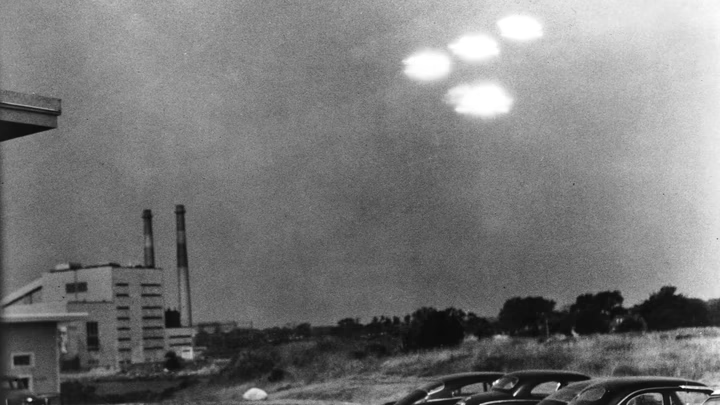
Such physical incongruences is what made several members of Bigelow’s NIDS team to throw their arms in frustration at the ‘light that did not behave like light’, as reported by Jacques Vallée in his Forbidden Science journals.
Massimo’s second paper is the one I find more valuable, despite (or perhaps on account of) being the ‘less scientific’ one by invoking the possibility of telepathic interactions and plasma-based forms of consciousness. Massimo didn’t shy away from speculating a possible link between the UFO phenomenon, the ZPE field, and what we call ‘the soul’. Personally, invoking the need to keep the ETH open with the idea of ‘galactic intelligences’ popping in once in a while to check on the progress of their ‘plasma probes’ —why not make your intentions more easily understood beyond playing with colors and geometry?—seems unnecessary with a phenomenon that is already weird enough.
Perhaps we should go back and take a second look into the ancient traditions that believed the spirits of the dead reside in the features of the landscape—the mountains, the rivers, etc—and once in a while they can re-enter our waking world to briefly interact with the living. That would still leave out the pesky issue of structured craft and physical traces on the ground, of course; but while the large majority of close encounters could be the result of temporal lobe hallucinations, as suggested by Persinger and the Condign report, the small percentage of cases with physical interactions might share more in common with the ’apports’ of spiritual seances than with space probes traversing wormholes.

But I could understand why ‘getting to woo’ would be frowned upon by an analytical mind like Massimo’s. Regardless, nobody could disagree with his plea for more multi-sensory ground data, and I think he is a good role model for any scientist willing to make sense of anomalous phenomena, while sticking to the scientific method which has allowed to make sense of much of the natural world.

